
What is Internet Protocol Version 6?
By the mid-1990s, IPv6 was developed as an IPv4 replacement. IPv6 (Internet Protocol version 6) is a new version of IP protocol designed to solve problems that the previous version (IPv4) encountered by using an address length of 128 bits rather than 32. The protocol was developed by IETF.
IPv6 was specifically designed to solve address space exhaustion. Experts began to point out concerns about the exhaustion problem even in the 1980s. In addition, shortly after the launch of IPv4, its limitations in terms of scalability and capability became apparent. IPv4 was in need of some add-ons, such as ICMP and ARP, to work. The depletion of the IPv4 address space was the motivating factor for the transition to IPv6. As world gained more and more connection to the global Internet, a shortage of IPv4 addresses became an issue. The demands on the Internet were growing, and IPv6 responded better than the previous version.
IPv6 address space will be allocated by the IANA (Internet Assigned Numbers Authority), which has regional representatives who deal with issuing IP addresses in their areas. IANA is able to redistribute address space at any time if errors are made in allocation.
How fast is IPv6 adoption?
According to Google's open statistics about IPv6 adoption, the percentage of users that have accessed Google through IPv6 has reached 45%, as of October 2023. Based on these statistics, it could be stated that the world is gradually moving towards transition to IPv6.
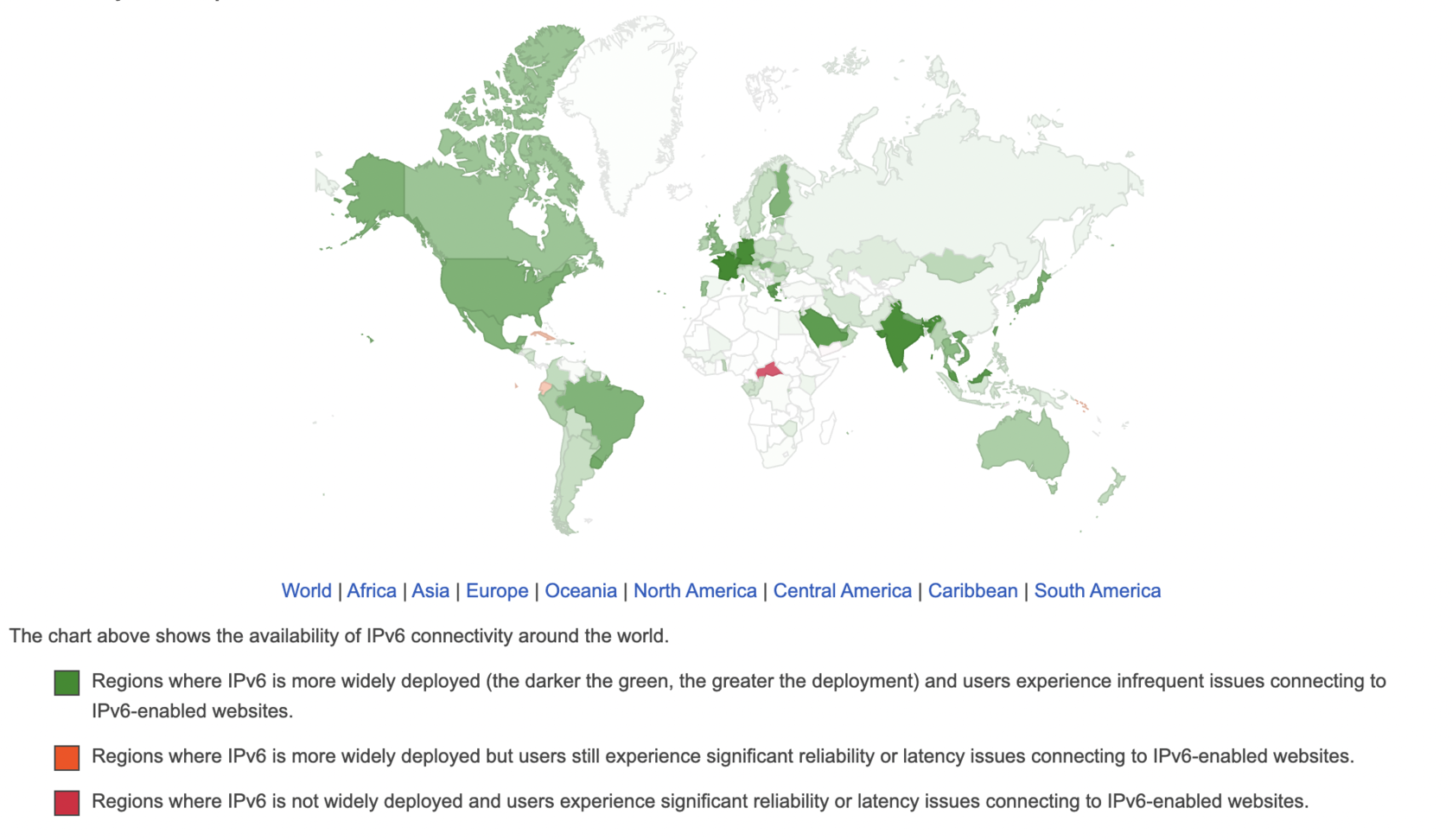
The Google chart above shows countries where IPv6 is more widely deployed (the darker the green, the greater the deployment)
The most active countries using IPv6 protocol are France (73.39%), Germany (71.72%), India (70.33%), Malaysia (63.16%), Belgium (62.68%), Saudi Arabia (61.19%), and Greece (60.01%).
Uruguay (52.64%), Brazil (49.96%), the United States (47.93 %) and Finland (46.62%) are slightly behind with Mexico, Canada, UK, Estonia and Puerto Rico. Furthermore, it is important to note that Google has a weak presence in China and information regarding IPv6 adoption in China might not be correct.
Why not just switch to IPv6?
The answer is cost. It takes a great deal of money and time to upgrade all the servers, routers and switches that depend only on IPv4. Despite the problems associated with the transition to a new version of Internet Protocol, this is an important and significant step for everyone, without exception.
The transition to IPv6 is inevitable. It proceeds slowly, though, because the benefits of innovation are not obvious, at the moment, for most users. The first to come onboard are those countries where the shortage of addresses is felt the most acutely.
How long will it take to migrate to IPv6 completely?
IPv6 adoption varies, with some companies delaying its deployment while others adopt it actively. Most networks will operate on both IPv4 and IPv6 for years. The COVID-19 pandemic, which increased remote work, has influenced network traffic and may boost IPv6 growth.
Even as global momentum shifts towards the widespread adoption of IPv6, the entrenched legacy and infrastructure of IPv4 ensures its continued relevance. Decades of reliance on IPv4 have created a deep-rooted foundation that won't be easily or quickly replaced. As such, despite the undeniable advantages and expanding reach of IPv6, our dependence on IPv4 will persist for a significant duration, underlining its enduring significance in the digital landscape.
Thus, technologies like Carrier-Grade NAT (CGNAT) play a crucial role in ensuring that ISPs can efficiently manage and utilize the dwindling IPv4 resources during this transitional period. CGNAT allows to share one IPv4 address among dozens of subscribers, and ensure smooth transition to IPv6.
In conclusion, the emergence of IPv6 marks a significant evolution in the realm of internet protocols, designed to address the limitations and impending exhaustion of IPv4 addresses. While the benefits of IPv6 are evident, its global adoption has been a journey of gradual integration rather than swift transition. As the world inches closer to a more connected future with an ever-growing number of devices, the shift to IPv6 becomes not just beneficial but imperative. However, the coexistence of IPv4 and IPv6 will likely characterize the digital landscape for years to come, underscoring the importance of understanding and facilitating this monumental technological transition.