
Build an IPv4 address budget from dated observations for the block size and transfer conditions you need. Separate completed sales from asking prices, then add transaction charges and ongoing operating costs. Leasing and cloud public-address charges use different units and require separate calculations. This guide's source review is dated October 29, 2026. It does not assign one universal market price: the reviewed September market commentary provides direction, but not a complete, comparable numeric transaction sample. The worked budget below uses labeled assumptions so you can replace them with validated quotes without confusing the model with a market index.
On this page
Start with a Dated Price Range, Not a Permanent Number
Record a range from comparable observations, with its period and source, before seeking approval for an acquisition. An IPv4 price from a 2022 article cannot establish today's cost. Nor does an upward move in a recent monthly report prove that prices rise continuously. IPv4 Global's September 2026 report describes stronger pricing and a narrowing gap between large and small blocks. Treat that as the marketplace's reported context. Obtain the underlying observations or current comparable quotes before converting it into a numeric purchasing range.
For an ISP, the useful question is how much address space will be usable by the required date and what that space will cost over the planning horizon. A low quoted price can be poor value if the transfer arrives after an access-network launch or the block needs substantial reputation work.
Keep a quote's validity date in the budget. Review the assumptions when the project changes its activation schedule, registry region or required prefix sizes. Retain prior versions so finance and engineering can see why the requested amount changed.
Make Market Observations Comparable
Block Transactions and Quoted Offers
Use one observation register with explicit data types. A completed transaction records a price achieved under particular conditions. An offer records a seller's request, which may change during negotiation. A monthly market summary can combine transactions from sizes and regions that differ from your own requirement.
| Source reviewed on October 29, 2026 | Observation period | Unit and data type | Numeric use in this guide | Limitation |
|---|---|---|---|---|
| IPv4 Global September report | September 2026 | Marketplace commentary on transfers | No transaction price extracted | No complete comparable numeric sample in the reviewed page |
| ARIN fee schedule | Applicable schedule at review | Registry and transfer-related charges | Obtain the fee category for the organization | Registry charges do not purchase a block |
| AWS VPC pricing | Published tariff at review | USD per public IPv4 address-hour | $0.005 for standard in-use or idle public IPv4 | Cloud service charge, not an address-space transfer |
The source register is not a market-price comparison. To add a transfer quote, record the prefix, address count, registry, currency, quote date, expiry, transfer conditions and included fees. Preserve whether the amount covers one block or a package of several blocks. Reject records whose unit or conditions cannot be established.
Recurring Lease and Cloud Charges
Keep recurring prices in their native units before normalizing them. A monthly lease may involve a minimum term, setup fee and restrictions on routing or use. A cloud charge applies within the provider's service and may include platform-specific conditions. Neither is equivalent to buying transferable address space.
As reviewed on October 29, 2026, AWS lists a standard public IPv4 charge of $0.005 per address-hour for in-use and idle addresses. At that rate, one continuously billed address over a 30-day, 720-hour month costs $3.60, before other services or applicable charges. AWS lists other address products separately. Verify the relevant tariff rather than extending this example to every allocation type.
Convert currencies using one named rate source and one conversion date for the comparison. Preserve the original amount beside the converted value. Do not compare a tax-inclusive lease with a tax-exclusive purchase unless the tax treatment is explicit.
Explain What Changes the Price of a Block
The address count follows the prefix size: an IPv4 /22 contains 2^(32−22), or 1,024 addresses. That count supports a budget calculation; it does not establish how many addresses your deployment can allocate. Reserve needs, subnet design, service policy and routing requirements affect the usable inventory. See the IPv4 reference for the underlying address model.
Compare block sizes against actual demand. A single large block may simplify some operations, while several smaller blocks may fit staged growth. Check transfer eligibility, registration records and the operational ability to announce the resulting prefixes. Confirm acceptance with intended upstreams; a mathematical prefix calculation does not guarantee global reachability.
Assess address reputation for the services you intend to run. A routing check alone will not reveal every mail-delivery or third-party filtering problem. Ask who handles remediation, which evidence the seller provides and what the contract permits if a problem appears. Include the investigation and lead time in the acquisition plan.
Avoid assuming a fixed large-block discount. Compare current observations for the relevant sizes. Historical package transactions can affect averages, and a marketplace's mix of sales can change from one period to the next.
Add the Costs Outside the Headline Price
Split costs into acquisition, recurring ownership or lease obligations, and operational work. Keep a responsible owner for each line so the same charge does not appear twice.
| Cost line | Timing | Budget treatment |
|---|---|---|
| Block purchase or lease | One-time or monthly | Use the validated agreement and address count |
| Broker, escrow and transfer processing | Per transaction, as applicable | Record payer and whether the quote includes it |
| Registry or account services | Recurring and transaction-specific | Apply the organization's actual category |
| Registration and route preparation | Initial work and later changes | Include staff or supplier effort |
| Reputation investigation and remediation | Before use and during operation | Estimate a separate allowance |
| Routing, monitoring and abuse handling | Ongoing | Allocate costs using the operator's method |
ARIN's fee schedule describes registration services and transaction charges. Determine the applicable organization and resource category before entering a fee. Do not add an arbitrary ARIN amount to every address as if the registry sold it at that price.
Model cash timing as well as totals. A purchase may require payment before the network can use the block. A lease spreads payments but creates an ongoing dependency. Keep accounting treatment, financing and taxes with the finance team rather than hiding them in an assumed per-address operating cost.
Build a Transparent ISP Budget
Consider an illustrative three-year planning model, not a quote or forecast. An ISP needs 800 additional public addresses at launch. It assumes 20% extra inventory relative to that requirement for reserve and growth: 800 × 1.20 = 960. For this example it chooses a /22 containing 1,024 addresses. Confirm the actual allocation policy before using all of that inventory in a service plan.
The model uses an assumed purchase price of $30 per address, $2,000 of one-time costs and $1,200 of annual costs. These amounts are invented inputs for arithmetic; they do not describe a current supplier tariff or NFWare deployment.
Purchase budget = address count × purchase price + one-time costs + annual costs × years.
For this example: 1,024 × $30 + $2,000 + $1,200 × 3 = $36,320 over three years. The first-year cash requirement is $33,920 if the purchase, one-time work and first annual payment all fall in that year.
Calculate a lease separately. Assume a hypothetical $0.50 per address-month, $500 setup and $600 annual operating costs for the same 1,024 addresses and 36 months.
Lease budget = address count × monthly lease price × months + setup + annual operating costs × years.
Here: 1,024 × $0.50 × 36 + $500 + $600 × 3 = $20,732. The model excludes discounting, financing, taxes and any end-of-term asset value. It also assumes the lease remains available on those terms throughout the horizon. Its lower modeled total is not a recommendation to lease: the two options can have different control, continuity and contractual conditions.
Test the Budget Against Uncertainty
Change one input at a time before combining risks. Keep the same 1,024-address inventory, $2,000 one-time costs and $1,200 annual costs in the purchase example. Vary only the assumed acquisition price.
| Illustrative price input | Address acquisition | Three-year total |
|---|---|---|
| $24 per address | $24,576 | $30,176 |
| $30 per address | $30,720 | $36,320 |
| $36 per address | $36,864 | $42,464 |
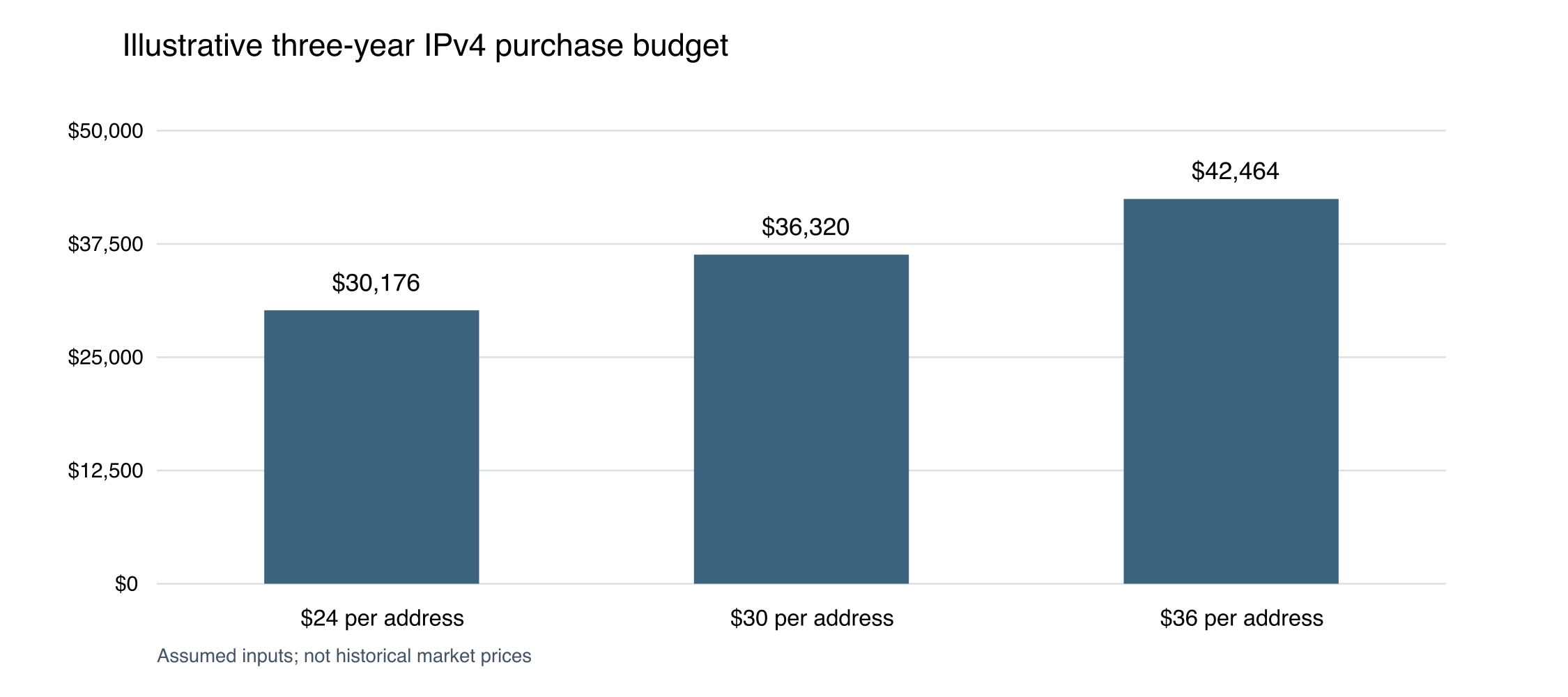
03-ipv4-budget.csv.Next test demand growth and delivery delay. Crossing a prefix-size boundary can change the required inventory in a step rather than a smooth percentage. A delayed block can create temporary connectivity costs or postpone revenue. Record those scenarios separately from price movement.
CGNAT and IPv6 deployment can change the residual public IPv4 requirement. Estimate that change from your network's ports, sessions, subscriber products and traffic. A global IPv6 percentage cannot establish how many public addresses your ISP can release. Keep the full technology comparison in the separate addressing strategy discussion.
Maintain the Price Dataset
Assign an owner to review sources each month and whenever a quote expires. Keep the original observation, its URL or document identifier, retrieval date and inclusion decision. Distinguish an unchanged source from an updated price.
Build a historical chart only after collecting comparable numeric observations. Use consistent block-size groups, currency rules and transaction types. Mark gaps instead of filling them with assumed prices. If a supplier changes its methodology, annotate the break rather than drawing a continuous line through incompatible values.
The supplied dataset includes this guide's source register and model inputs. It contains no invented market-price time series. Add verified transaction observations before publishing a chart described as an IPv4 price index. Preserve 2021–2022 observations as history with their original dates.
Frequently Asked Questions
How should cloud hourly IPv4 charges be compared with block purchase prices?
Convert the hourly charge to the same planning horizon using the expected billed hours, then keep it in a separate service-cost column. A cloud public-address tariff covers use within that provider's platform. A transferred block has different rights, operating costs and reuse conditions, so matching units alone does not make the options equivalent.
What should an ISP do when current transaction data is unavailable?
Request dated quotes for the required sizes and conditions, label them as offers and retain their expiry dates. Use a sensitivity range for approval rather than an unsupported market average. Record the evidence gap, obtain a comparable transaction sample when possible and revise the budget before committing funds.
Which costs should be added to a quoted price per IPv4 address?
Confirm included commissions first, then add applicable transfer processing, registry services, routing preparation, reputation checks and operating work. Separate one-time charges from recurring payments. Identify the payer and billing period for each item, and keep taxes, financing and accounting treatment explicit in the organization's financial model.
Use the Budget to Choose the Next Decision
Take the requirement, prefix inventory, dated quotes and full cost register into the addressing review. Agree the activation deadline and continuity conditions as well as the amount. Compare residual IPv4 demand under the proposed IPv6 and sharing plans before acquiring excess inventory.
If translation forms part of that plan, evaluate NFWare Virtual CGNAT against measured session, port and failure requirements. Keep its technology budget separate from the address-price dataset so a future price update does not silently change the deployment assumptions.